
What Is the Towing Capacity of the 2026 Ford F-150 in Winnipeg?
What Is the Towing Capacity of the 2026 Ford F-150 in Winnipeg?
Posted on September 22, 2026
When you need a truck that can handle everything from weekend recreation to serious work, towing capacity becomes one of the most important numbers to consider. The 2026 Ford F-150 offers a broad range of engines and configurations, giving drivers the flexibility to choose a setup that matches what they plan to tow.
For Winnipeg drivers, that could mean pulling a utility trailer across the city, hauling recreational equipment outside Headingley, or taking a heavier trailer toward Selkirk or Stonewall. The maximum towing capacity of the 2026 F-150 reaches 6,123 kgs (13,500 lbs.) when properly equipped, but the exact rating depends on the engine, configuration, equipment and payload.
How Much Can the 2026 F-150 Tow?
The headline figure is 6,123 kgs (13,500 lbs.), available with the 3.5-litre EcoBoost V6 when properly equipped with the required Tow/Haul Package and Max Tow Axle upgrade. That makes it one of the strongest towing options in the F-150 lineup.
The available engines provide a wide range of towing capabilities. The 2.7-litre EcoBoost V6 produces 325 horsepower and 400 lb-ft of torque and can tow up to 3,946 kgs (8,400 lbs). The 3.5-litre EcoBoost V6 raises output to 382 horsepower and 500 lb-ft of torque, with maximum towing reaching 6,123 kgs (13,500 lbs.)
The 3.5-litre PowerBoost Full Hybrid V6 produces 420 horsepower and 570 lb-ft of torque, while offering up to 5,261 kgs (11,600 lbs). of towing capability. The 5.0-litre Ti-VCT V8 delivers 400 horsepower and 410 lb-ft of torque and can tow up to 5,805 kgs (12,800 lbs). when properly equipped.
For performance-focused drivers, the available 3.5-litre EcoBoost High-Output V6 produces 450 horsepower and 510 lb-ft of torque, while the 5.2-litre supercharged V8 in the Raptor R produces 720 horsepower and 640 lb-ft of torque. Their maximum towing ratings are 3,719 kgs (8,200 lbs.) and 3,946 kgs (8,700 lbs.), respectively.
Choosing the Right F-150 Engine for Your Trailer
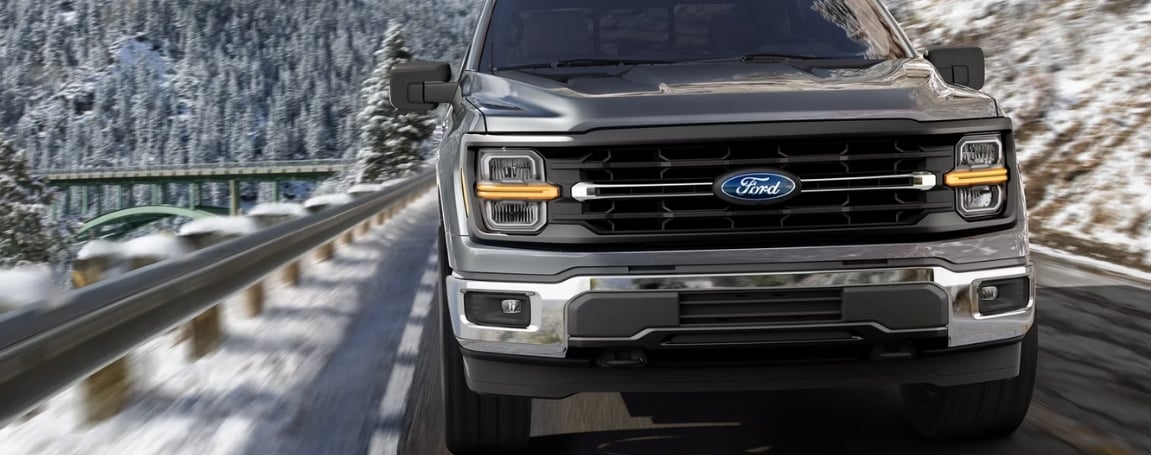
With six available engine choices, the 2026 F-150 gives Winnipeg truck shoppers plenty of ways to match their powertrain to their towing needs. A driver who occasionally pulls a smaller utility or recreational trailer may find the 2.7-litre EcoBoost provides plenty of capability.
For heavier towing, the 3.5-litre EcoBoost stands out with its 500 lb-ft of torque and 6,123 kgs (13,500-lb.) maximum rating. The 5.0-litre V8 is another strong choice, particularly for drivers who prefer traditional V8 power and need up to 5,805 kgs (12,800 lbs). of available towing capability. The PowerBoost hybrid adds another approach, combining 420 horsepower and 570 lb-ft of torque with up to 5,261 kgs (11,600 lbs). of towing capability. This can make it an appealing option for drivers who want substantial towing strength alongside the versatility of a hybrid powertrain.
It is important to remember that these maximum figures are not all achieved simultaneously. Towing and payload ratings vary according to vehicle configuration, cargo, accessories, passengers and other equipment.
Towing Capacity Is Only Part of the Equation
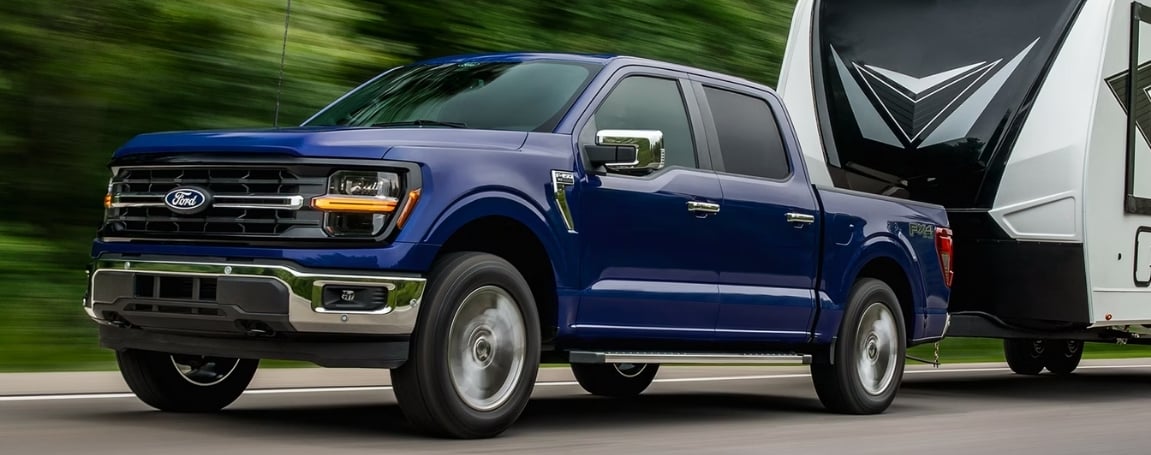
It is easy to focus on the largest towing number, but payload is just as important when choosing a truck for regular towing. The trailer itself is not the only weight the F-150 has to carry. Passengers, cargo and trailer tongue weight all count toward the truck's available payload. Depending on the engine and configuration, maximum available payload ranges from 1,405 lbs. to 2,440 lbs. The 3.5-litre EcoBoost reaches up to 2,440 lbs. of available payload, while the 2.7-litre EcoBoost is rated for up to 1,775 lbs.
Ford recommends keeping the trailer tongue load at approximately 10% of the total loaded trailer weight for conventional towing. The combined weight of passengers, cargo and tongue load must remain within the truck's applicable GVWR and rear GAWR. That means a trailer that falls below the F-150's maximum towing rating can still require careful consideration of the truck's payload capacity.
What About Fifth-Wheel and Gooseneck Towing?
The F-150 is also available for fifth-wheel and gooseneck applications, although the ratings vary significantly depending on the engine, cab, axle ratio, wheelbase and configuration.For example, Ford's towing information shows configurations of the 3.5-litre EcoBoost reaching up to 10,300 lbs. for fifth-wheel/gooseneck towing under specific conditions. The 5.0-litre V8 can also provide substantial fifth-wheel/gooseneck capability in properly equipped configurations.
Because these ratings are configuration-specific, Winnipeg drivers planning to tow a fifth-wheel or gooseneck trailer should confirm the exact rating of the F-150 they are considering rather than relying on the conventional towing maximum.
Technology That Makes Towing More Manageable
The 2026 F-150 pairs its engine choices with a 10-speed automatic transmission designed to provide optimized gear spacing, low-rpm torque and efficient operation. Selectable Drive Modes also help adapt the truck to changing driving conditions and scenarios.
For towing, available Tow/Haul mode can help reduce unwanted gear changes while climbing and assist with vehicle speed control when descending. The available Integrated Trailer Brake Controller can also help provide smooth, effective braking for trailers equipped with electric or electric-over-hydraulic brakes. These features can be particularly useful when towing through changing Manitoba conditions, where drivers may encounter wet pavement, snow, wind or varying road surfaces during the same trip.
A Few Towing Habits Make a Big Difference
Good towing starts before the truck leaves the driveway. Cargo should be distributed properly, with approximately 60% of the allowable cargo weight positioned in the front half of the trailer and 40% in the rear, while staying within the applicable tongue-load limits. The load should also be balanced from side to side and securely fastened.
Before heading out, check the hitch connection, trailer lights, electrical connections, tire pressures and wheel lug nuts. Ford also recommends stopping after about 80 kilometres in a protected location to double-check the hitch, lights, electrical connections and trailer wheel lug nuts.
When backing up, take it slowly and use a spotter when possible. Allow additional stopping distance, swing wider when turning and exercise extra caution when accelerating or passing because of the added length and weight of the trailer.
Which F-150 Is Right for Towing in Winnipeg?
There is no single F-150 configuration that is perfect for every towing job. The right choice depends on the trailer you plan to pull, how frequently you tow, how much cargo and passenger weight you normally carry, and whether you need conventional or fifth-wheel/gooseneck capability.
For drivers looking for the highest conventional towing capacity, the 3.5-litre EcoBoost reaches an impressive 6,123 kgs (13,500 lbs). when properly equipped. The 5.0-litre V8 offers up to 5,805 kgs (12,800 lbs) while the PowerBoost hybrid provides up to 5,261 kgs (11,600 lbs) and 570 lb-ft of torque. The key is to select the truck around your actual trailer and load rather than simply choosing the highest number on the chart. Configuration, equipment and payload all affect what your specific F-150 can safely tow.
Find Your F-150 Towing Match in Winnipeg
Whether you are looking for a capable work truck, a vehicle for recreational towing or a versatile pickup for both, the 2026 F-150 gives Winnipeg drivers plenty of ways to build the right combination of power and capability. From the 2.7-litre EcoBoost to the available V8 and PowerBoost options, there is an F-150 suited to a wide range of towing requirements.
If you are comparing options for 2026 Ford F-150 towing capacity in Winnipeg, MB, the team at River City Ford in Winnipeg, MB can help you look at the engine, configuration and trailering equipment that best match your needs. Explore the available F-150 options and find the right truck for your next towing job.